This article was written and submitted by Lucy Conger, C.W. ’68.
The Trump administration proposed a deal last fall to nine leading universities: if you restrict academic freedom, cap admission of foreign undergraduate students and freeze effective tuition rates for five years, your school will get preferential treatment for federal funding.
Students, faculty and alumni groups came together to contest this challenge to university autonomy. The deal was rejected outright by seven of the schools. Trump’s proposal, the Compact for Academic Excellence in Higher Education, consists of ten demands, including:
- eliminate consideration of sex and race in admissions,
- define sex identity by reproductive functions,
- ensure that academic departments and faculty include a mix of ideological perspectives and programs, and
- ban political and social statements by employees on behalf of the university.
The document was issued on October 1, 2025, universities were asked to provide feedback by October 20 and the final deadline for responding to the government was November 21.
How Universities Responded
The Massachusetts Institute of Technology led the wave of rejections with a strong No sent to Education Secretary Linda McMahon on Oct. 10. MIT President Sally Kornbluth said the Compact “includes principles with which we disagree,” adding MIT policy is guided by “a clear set of values” that include “rewarding merit” and “free expression, as clearly described in the MIT Statement on Freedom of Expression and Academic Freedom.”
Brown University President Christina H. Paxson followed, expressing concern that the Compact “would restrict academic freedom and undermine the autonomy of Brown’s governance.”
Penn was next to turn down the Compact. “We are committed to merit-based achievement and accountability,” University President J. Larry Jameson said in his reply on October 16. He pointed out that his statement was informed by consultations with faculty, alumni, trustees, students and staff “to ensure that our response reflected our values and the perspectives of our broad community.”
Penn’s rejection was significant as Pres. Trump is a graduate of Wharton (68). Another Penn grad, billionaire financier Marc Rowan (W85), Co-Founder, CEO and Board Chair of Apollo Global Management, was a leading influence in drafting the Compact.
The University of Southern California, University of Virginia, Dartmouth College and University of Arizona also turned down the Compact.
Vanderbilt University and University of Texas at Austin are hold-outs. Vanderbilt University Chancellor Daniel Diermeier said the university would provide feedback on the proposal in the future, adding, “We have not been asked to accept or reject the draft compact.” UT at Austin has not responded publicly to the Compact.
Penn Students, Professors and Alumni Take a Stand
At Penn, several groups acted quickly to the[LC1] perceived threat to academic freedom and defend the University’s integrity. The Penn chapter of the AAUP (American Association of University Professors) issued a sharp response the day after the Compact’s release. The AAUP-Penn statement said Penn must uphold “its self-determination” and denounced the “attempt at coercion” as an example of “intensifying political interference into higher education.”
GET-UP UAW and RAP-UP UAW, unions of graduate student research and teaching employees and research associates and postdocs respectively, endorsed the faculty statement and called on the Penn community to sign a petition demanding the Compact’s rejection. By October 15, that petition had been signed by 1,920 Penn community members, including more than 670 faculty, 440 students, 410 alumni and 250 staff. The next day, Jameson issued the official thumbs down to the Compact.
Pennsylvania Governor Josh Shapiro then expressed his “full support” of the University’s decision. In an Instagram post, he said the Compact “would limit freedom of speech, the freedom to learn, and the freedom to engage in constructive debate and dialogue in campuses across the country.”
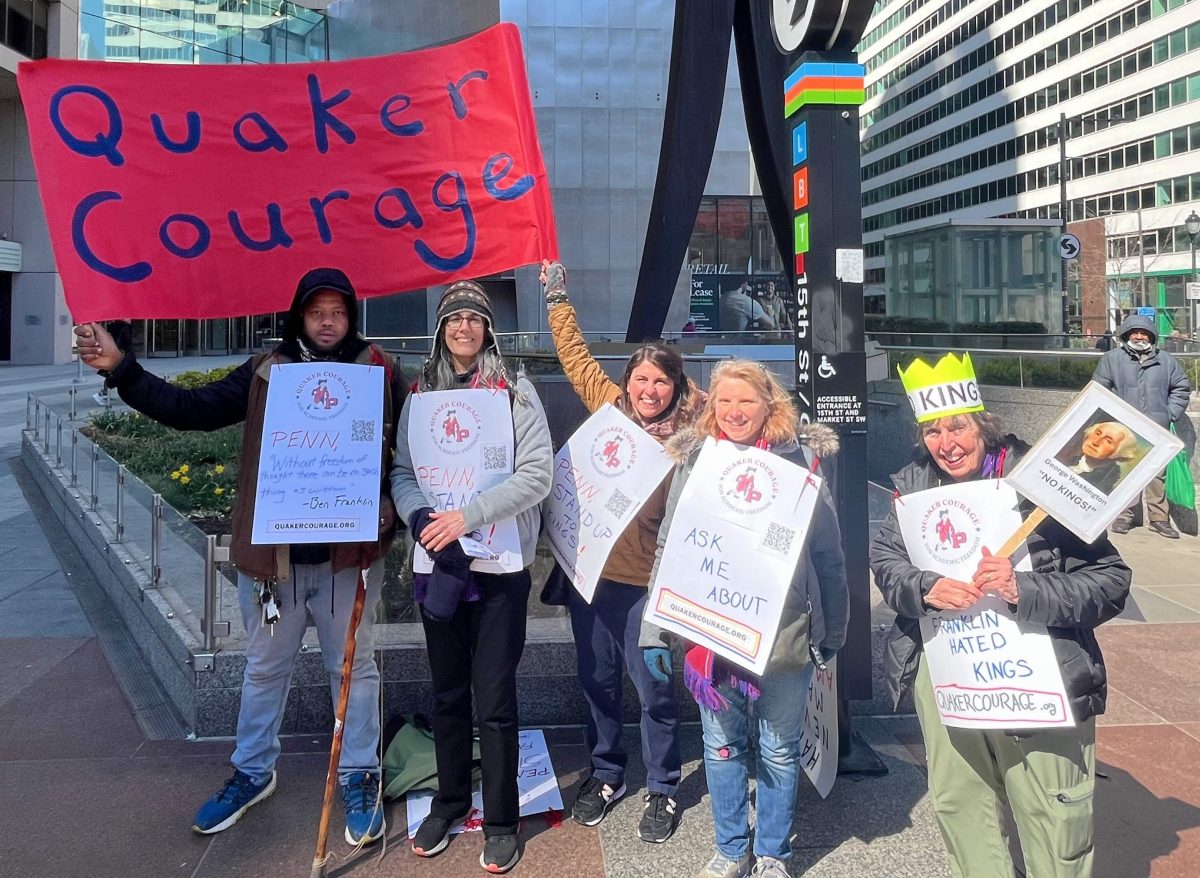
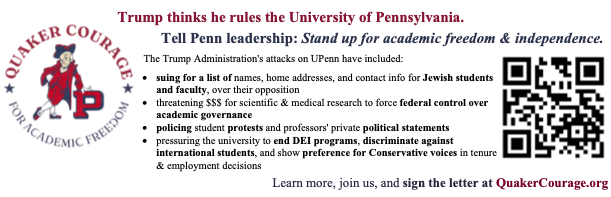
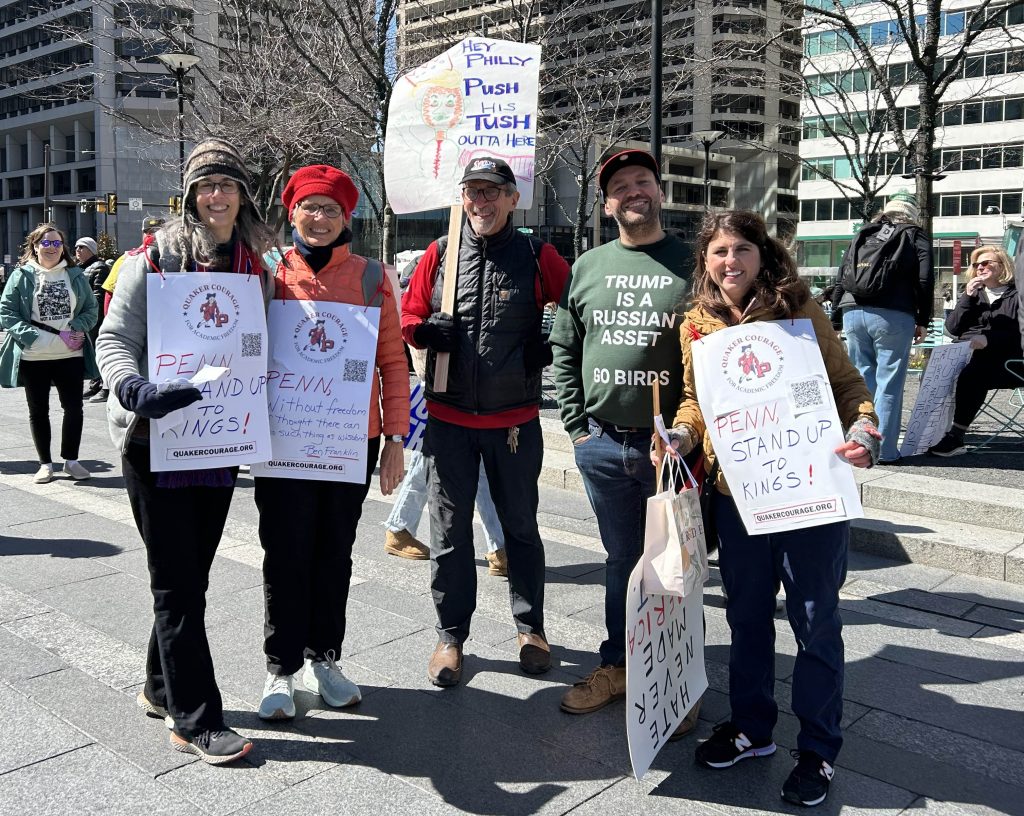
Several groups of Penn activists have come forward to defend the University’s academic integrity and autonomy, including Alumni for Freedom and Democracy and Quaker Courage[LC2] .
Alumni for Freedom and Democracy (AFFD), a group of Wharton Grad alumni, was formed in April 2025 as a cross-partisan community committed to preserving the essential freedoms that sustain an open society – freedom of thought, civil dialogue, democratic principles and economic opportunity.
Led by Chris Malone (W. ’91), also an officer of his class, AFFD took on academic freedom as its first initiative and launched a statement in support of Penn’s signing of AAUP’s Call for Constructive Engagement last May. “We’re focused on taking principled action in defense of liberty for all. As Wharton alumni, defending academic freedom was a natural starting point,” says Malone.
Ritika Arora (Med ’99), a member of the Quaker Courage executive committee, stated, “The universities in Texas succumbing to Trump’s demands are now not allowed to teach Plato and have eliminated women’s studies programs.” Arora spurns the premise of the Trump-proposed Compact, saying, “Democracy doesn’t work with bribery.”
National Opposition to Government Intervention
The Compact sparked a national movement. As the deadline approached for responding to Trump’s Education Secretary McMahon, opposition mounted. On November 7, students, faculty and staff protested at 100 universities around the country to demand that their schools say No to the Compact. The organizers were Students Rise Up, a student movement, that was supported by labor unions, the AAUP, Public Citizen and other groups. “The attacks on higher ed are attacks on truth, freedom, and our future. We’re organizing to protect campuses as spaces for learning, not control—for liberation, not censorship,” said Brianni Davillier, a student organizer with Public Citizen, an advocacy group.
In New York City that day, the demonstration called for getting billionaires and their influence out of higher education, an allusion to Marc Rowan, the hedge fund CEO who aided the Trump administration in preparing the Compact. A faculty rally against Rowan was followed later in the day by a picket on 57th Street outside Apollo Global Management headquarters.
Rejection of the Compact cannot be expected to close the door on Trump administration efforts to intervene in academia. On Feb. 3, 2026, President Trump demanded a $1 billion payment from Harvard University to settle an ongoing dispute that began with a cutoff of federal research funds and an effort to prevent the school from admitting foreign students. Today, campuses can claim a growing number of organizations dedicated to preserving academic independence and freedom of thought and debate.