Featured

Sign our letter to Penn’s leadership

Quaker Courage has drafted a letter to Penn President J. Larry Jameson and the Board of Trustees. Add your name!

In the letter, we call on Penn to hold fast to its values.

Academic freedom is central to the identity of Penn, an institution built on the vision of Benjamin Franklin. We call on the University of Pennsylvania administration to do the following:

  • Re-commit to academic freedom in admissions and employment, curricular and departmental independence, research, and intellectual debate
  • Defend students’ and faculty’s speech, protest, and privacy rights
  • Protect safety of immigrant and international students, faculty, and staff
  • Reinstate eliminated DEI programs
  • Reject any future demands, agreements, or “offers” from the Administration or other political actors that would violate the above commitments

The full letter is hosted by our partners at Stand for Campus Freedom, an organization that “unites alumni across generations, geographies, and viewpoints to protect academic freedom and stand up for democracy.”

After signing, please share the letter with alumni, faculty, students, allies, and anyone else you think will add their name now to stand up for campus freedom.

Good news—‘List of Jews’ subpoena dropped! 

On April 13, 2026, the University of Pennsylvania appealed a federal court ruling ordering the university to comply with an EEOC subpoena seeking identifying information about Jewish employees and Jewish-affiliated campus communities. Penn argued that forced compliance would cause “irreparable harm” because of the privacy and First Amendment rights at stake. The judge put the  disputed subpoena requirement on hold while the case played out in court. 

Last week, the EEOC and Penn reached an agreement that appears to protect the privacy of Penn employees and student workers. As per a July 27, 2026 court filing, the “EEOC warrants that it will not take any further measures to enforce the subpoena seeking identification and personal contact information of employees of the University of Pennsylvania.” In return, Penn has dropped its appeal against the EEOC. The court filing also stipulates that “that each party shall bear its own costs and attorney’s fees.” 

The EEOC dropped its subpoena demands following deep backlash from the Penn community and elsewhere. Public pressure works!

Take Action: Urge Penn to restore open expression on campus

Penn has been trying to push through a troubling new “open expression” policy under the radar. The policy is still a draft, but the administration is trying to pass the policy early in the fall 2026 semester.

Use the button below to email Provost, Dr. John L. Jackson, Jr. and President J. Larry Jameson and voice your concerns.

What’s in the proposed new open expression policy?

The new rules would:

  • Permanently restrict political speech without administration approval;
  • Hand discipline decisions to a new Executive Director, who answers only to the Provost; and
  • Potentially punish students, faculty, and staff for what they post on social media.

The old system had a safeguard: an independent Committee on Open Expression, appointed by the Faculty Senate with faculty, student, and staff representation. It interpreted the rules, updated them with community input, and reviewed discipline cases. The new draft strips away this committee’s power and gives it to one Provost-appointed staffer.

The revision process used by Penn was secretive from day one. University policy required feedback sessions in relation to the newly-drafted guidelines, but these happened only after students and faculty pushed hard for them — and then the President, Provost, and Task Force members skipped them entirely. Alumni were shut out here, too.

The result is far more restrictive than what came before. The old rules named a short list of violations and let the independent Committee interpret them case-by-case.  The new rules are rigid and bureaucratic in ways that don’t serve students’ growth as engaged citizens. Event and protest permissions are now harder to get. New social media rules ban livestreaming campus events and regulate speech both on and off campus.

Alumni Email template

The button above provides an email template for alumni, pre-addressed to Penn’s president and provost. Simply add your name and Penn graduating class and hit send. Done! Or feel free to edit or add your personal concerns about Penn’s open expression guidelines. Either way, your voice matters!

Problem using the button?

Click here to write and paste text in your email message

Email addresses:
  Dr. John L. Jackson, Jr., provost@upenn.edu
  J. Larry Jameson, president@upenn.edu

Subject: Restore real open expression on campus

Dear [President Jameson / Provost Jackson],

I’m writing to express my concern about the crackdown on free expression at Penn.

I urge the university to restore the speech protections in place before 2024, and to bring back the independent Committee on Open Expression as the first line of response on conduct issues.

Please end the Temporary Standards now and return to the guidelines that served Penn well for fifty years.

Don’t shortchange today’s students on free speech and civic engagement. The years ahead will bring real chances for public debate — Penn voices shouldn’t be silenced during this critical moment in our nation’s history.

Sincerely,

[NAME]
Class of [YEAR]

Troubling Proposed Changes to Penn Open Expression Guidelines

This article was written and submitted by
Carolyn Marvin, Frances Yates Professor Emeritus of Communication
Diana Mutz, Samuel A. Stouffer Professor of Political Science and Communication
Robin Pemantle, Christopher H. Browne Distinguished Professor of Mathematics

The Guidelines on Open Expression are a Penn institution going back some 50 years. They were established to protect the speech of students and other Penn community members at events, meetings and peaceful demonstrations. They have seen the community through conflicts such as Vietnam, Fossil Fuel Penn and divestment demands.

In response to the peaceful Spring 2024 demonstrations, the University suspended the Guidelines and replaced them with very restrictive “Temporary Standards.” As a result, students, faculty and staff are no longer allowed to openly express political views on campus without prior approval of the Provost. These “temporary” rules have now been in effect for over two years.

The university appointed its own Task Force to revise the Guidelines permanently, contradicting its own written rules for revision of the open expression guidelines. Proposed Revised Guidelines were finally issued late in the Spring 2026 semester, generating numerous objections from constituencies throughout the university. The Senate Executive Committee issued a statement repudiating the Revised Guidelines, which public comment sessions had declared “unsalvageable.” Alumni were not welcome at these events which required university ID to attend. The timeline and process for final approval by the University Council is unknown at this point, but was originally planned for early September.  

Immediate Concerns:

Criticisms of the proposed new guidelines involve not only the top-down process by which they were generated, but also their inclusion of permanent restrictions on political speech by members of the university community without prior approval by the administration, disciplinary actions for speech to be decided by a new Executive Director of Open Expression under the control of the Provost, and discipline based on social media content posted by students, faculty or staff. 

The original Guidelines established an independent Committee on Open Expression appointed by the Faculty Senate, drawing representation from faculty, students and staff.  It issues interpretations of the Guidelines when questions arise, makes changes to the Guidelines with community input as needed, consults with the disciplinary arm of University Life before students are charged with violations of the Guidelines, and advises the administration on policies affecting open expression. Over the years this committee operated as a respected check on administrative overreach in policy and disciplinary matters. In the Revised Guidelines, the COE’s functions have been transferred to a staff member who is appointed by and reports only to the Provost. 

The revision process was, from the start, surreptitious and in contradiction to the University’s own rules for changing the guidelines. Mandated community feedback sessions were absent until pressure from students and faculty resulted in “listening sessions,” which the President, Provost and everyone on the Task Force failed to attend. In addition, alumni were not welcome at the listening sessions, which required current university ID.

The proposed new Open Expression Guidelines are far more restrictive than were the longstanding previous guidelines. Previously, a relatively small number of infractions were listed and the COE, a committee independent of the Provost, interpreted them.  This allowed for handling of complex issues and served as a check on single-handed interpretation by the university administration. The Revised Guidelines offer a highly rigid set of rules that are not conducive to students’ education as citizens. Permissions for student events and demonstrations have been bureaucratized in ways that chill expression. New rules on social media forbid livestreaming of campus events and constrain expression both offline and online.

Carolyn Marvin, Diana Mutz, and Robin Pemantle have been following this issue and previously wrote Stop the stealth passage of open expression restrictions at Penn for the Daily Pennsylanian.

Penn Quaker Courage at Alumni Weekend 2026

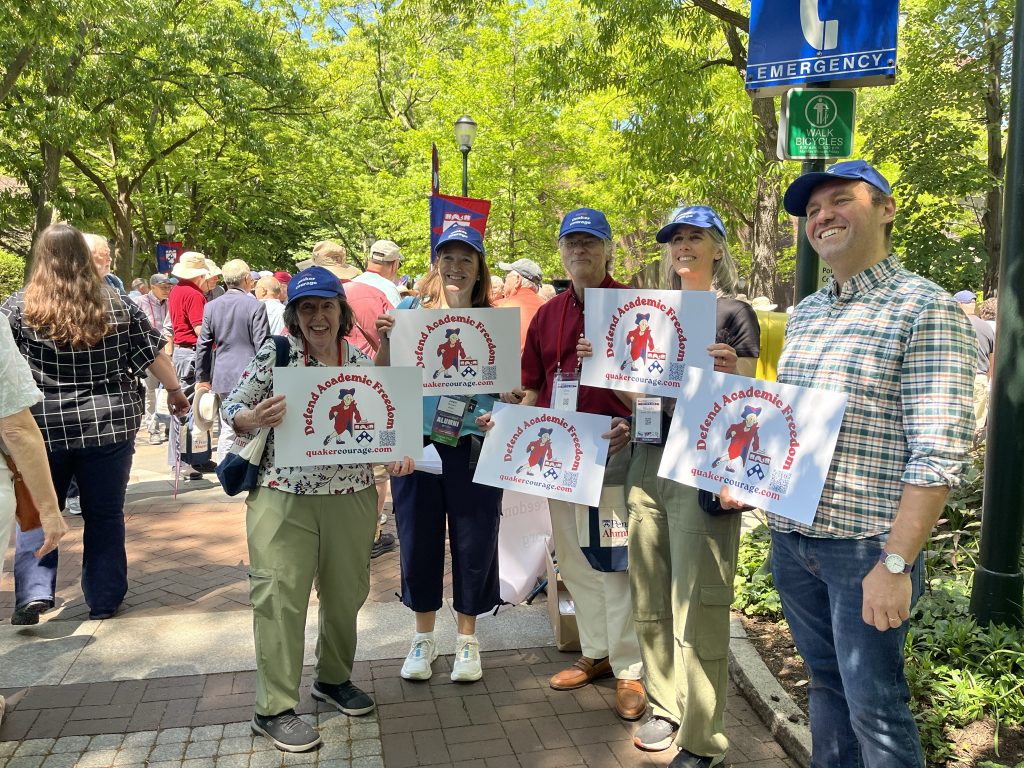
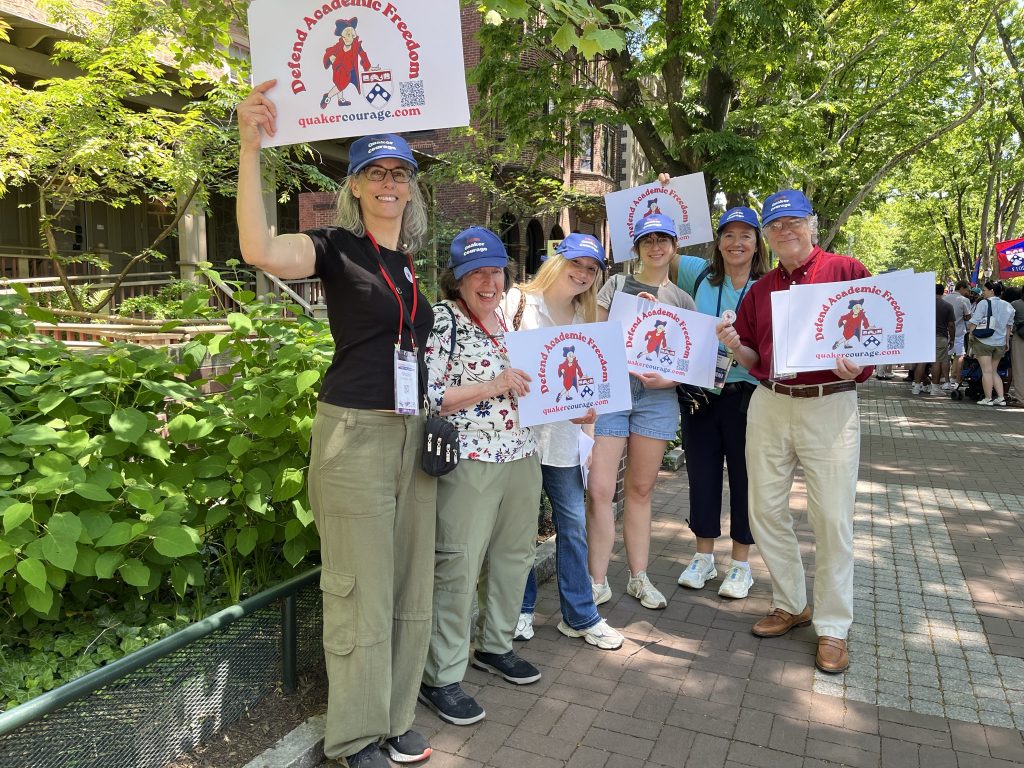
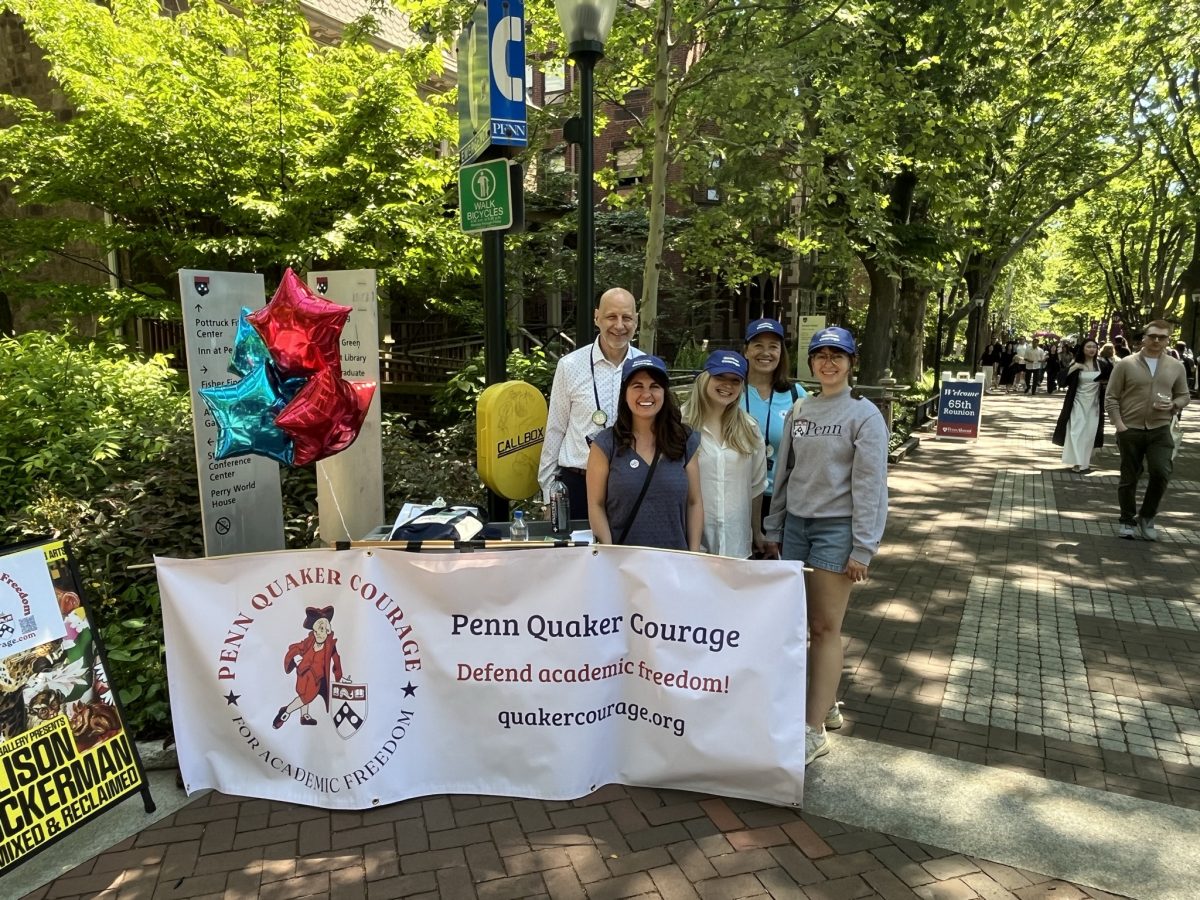
A multigenerational group of Penn Quaker Courage volunteers joined the festivities at Alumni Weekend May 15-17. We talked with alums, their families, and Penn faculty and staff members about the importance of urging Penn leadership to resist heavy-handed federal government attempts to control academic programs and University operations. Hundreds of participants accepted our fliers listing the key issues we are following and asking for signatures to our letter to President Jamison and Penn’s Board of Trustees. During the Parade of Classes, we held Penn Quaker Courage signs and offered these to marchers to carry. By the end of Alumni Weekend, far more Penn community members were aware of Penn Quaker Courage and how to support Penn in maintaining its integrity and independence in the face of government interference. Many thanks to the national organization Stand for Campus Freedom, as well as a generous individual donor, for funding our Penn Quaker Courage banner, signs, and stickers.

Join us for an organizing meeting

Tuesday, April 28 at 7:00 – 7:30 pm ET

Next Tuesday, April 28 at 7:00 – 7:30 pm ET, Penn Quaker Courage will hold an organizing meeting on Zoom. In the meeting, we will:

  • Introduce you to the Penn Quaker Courage team.
  • Discuss plans and volunteer opportunities for building our presence at Penn Alumni Weekend, May 15-17.
  • Update you on the EEOC lawsuit and discuss next steps for supporting Penn’s ongoing court battle.
  • Answer questions and hear your ideas about standing up for academic freedom.

Can’t make the meeting? You can still get involved:

  • Share our petition. The more voices speaking up, the stronger the case for the university’s resistance—and the harder it is to treat Penn as an “easy target.” We need more voices & more hands on deck.
    **Forward this email. Post it in alumni groups and student chats. Share on social media.**
  • We need help with Alumni Weekend! If you want to help spread the word about Penn Quaker Courage at Alumni Weekend (May 15-18), please complete this Alumni Weekend Sign-Up Form.
  • Want to get more involved with Penn Quaker Courage? Reply to this email. We need support across technical, financial, media, and outreach efforts

Thank you for standing with us. We will keep you updated at every step.
We hope to see you at the meeting Tuesday, April 28 at 7pm and look forward to your ongoing support.


Federal Judge Rules Penn Must Give the Federal Government Names and Identifying Information of Penn Jewish Community Members – Penn Declares Intent to Appeal

We at Quaker Courage applaud Penn’s leadership for swiftly announcing that Penn will appeal U.S. District Judge Gerald J. Pappert’s March 31 ruling that the Equal Employment Opportunity Commission (EEOC) was within its constitutional rights to demand Penn turn over the information about Jewish faculty, staff, and members of campus Jewish organizations.

The EEOC had filed suit against Penn for refusing to comply with a subpoena last November that sought detailed information about Jewish faculty, staff, and campus organizations. The subpoena was part of an investigation the EEOC began in 2023 into Penn’s treatment of Jewish faculty and staff; the agency claimed it needed this information to gather evidence from individuals who may have experienced or witnessed antisemitism at Penn.

Judge Pappert gave Penn until May 1 to provide the EEOC with the information.

Penn’s statement, issued a couple of hours after Pappert’s ruling, acknowledged that the EEOC has an important role to play in investigating discrimination but added, “We continue to believe that requiring Penn to create lists of Jewish faculty and staff, and to provide personal contact information, raises serious privacy and First Amendment concerns.”

Judge Pappas’s ruling dismissed such concerns, stating that “the constitutional claims are easily dispensed with.” He wrote that the EEOC’s pursuit of such information is not unusual when the agency investigates cases of possible discrimination. He also noted that the EEOC “no longer seeks any employee’s specific affiliation with any particular Jewish-related organization on campus.”

Members of Penn’s chapter of the American Association of University Professors (AAUP), which had submitted an amicus brief opposing the subpoena, said they also anticipate they will appeal Pappert’s ruling and request a stay of Pappert’s order while the case makes its way through the courts.

The legal tug-of-war between Penn and the EEOC has evidently not prevented the agency from figuring out how to reach at least some Penn community members it wishes to talk with. Alumni organization Franklin’s Forum reports that the EEOC has already begun contacting some of Penn’s Jewish Studies professors on their personal phones.

Lawyer and Wharton professor Amanda Shanor told the Daily Pennsylvanian that Pappert’s decision could set a precedent allowing the government to collect information about any minority group. “The constitutional freedoms at stake – to be able to join religious and civic groups of your choice, to attend events, and teach and research freely without worry that your name and contact information will be put on a government list – are foundational to our democracy,” she wrote.

We will continue to provide updates as this case unfolds.

[For more background on the EEOC’s subpoena and the agency’s charges of antisemitism at Penn, see our February 10, 2026 post, “Penn Seeks to Protect Privacy of Jewish Faculty and Staff.”]

Universities Reject Trump Compact and Stand in Defense of Independence in Academia

This article was written and submitted by Lucy Conger, C.W. ’68.

The Trump administration proposed a deal last fall to nine leading universities: if you restrict academic freedom, cap admission of foreign undergraduate students and freeze effective tuition rates for five years, your school will get preferential treatment for federal funding.

Students, faculty and alumni groups came together to contest this challenge to university autonomy. The deal was rejected outright by seven of the schools. Trump’s proposal, the Compact for Academic Excellence in Higher Education, consists of  ten demands, including:

  • eliminate consideration of sex and race in admissions,
  • define sex identity by reproductive functions,
  • ensure that academic departments and faculty include a mix of ideological perspectives and programs, and
  • ban political and social statements by employees on behalf of the university.

The document was issued on October 1, 2025, universities were asked to provide feedback by October 20 and the final deadline for responding to the government was November 21.

How Universities Responded

The Massachusetts Institute of Technology led the wave of rejections with a strong No sent to Education Secretary Linda McMahon on Oct. 10.  MIT President Sally Kornbluth said the Compact “includes principles with which we disagree,” adding MIT policy is guided by “a clear set of values” that include “rewarding merit” and “free expression, as clearly described in the MIT Statement on Freedom of Expression and Academic Freedom.”

Brown University President Christina H. Paxson followed, expressing concern that the Compact “would restrict academic freedom and undermine the autonomy of Brown’s governance.”

Penn was next to turn down the Compact. “We are committed to merit-based achievement and accountability,” University President J. Larry Jameson said in his reply on October 16. He pointed out that his statement was informed by consultations with faculty, alumni, trustees, students and staff “to ensure that our response reflected our values and the perspectives of our broad community.”

Penn’s rejection was significant as Pres. Trump is a graduate of Wharton (68). Another Penn grad, billionaire financier Marc Rowan (W85), Co-Founder, CEO and Board Chair of Apollo Global Management, was a leading influence in drafting the Compact.

The University of Southern California, University of Virginia, Dartmouth College and University of Arizona also turned down the Compact.

Vanderbilt University and University of Texas at Austin are hold-outs. Vanderbilt University Chancellor Daniel Diermeier said the university would provide feedback on the proposal in the future, adding, “We have not been asked to accept or reject the draft compact.” UT at Austin has not responded publicly to the Compact.

Penn Students, Professors and Alumni Take a Stand

At Penn, several groups acted quickly to the[LC1]  perceived threat to academic freedom and defend the University’s integrity. The Penn chapter of the AAUP (American Association of University Professors) issued a sharp response the day after the Compact’s release.  The AAUP-Penn statement  said Penn must uphold “its self-determination” and denounced the “attempt at coercion” as an example of “intensifying political interference into higher education.”

GET-UP UAW and RAP-UP UAW, unions of graduate student research and teaching employees and research associates and postdocs respectively, endorsed the faculty statement and called on the Penn community to sign a petition demanding the Compact’s rejection. By October 15, that petition had been signed by 1,920 Penn community members, including more than 670 faculty, 440 students, 410 alumni and 250 staff. The next day, Jameson issued the official thumbs down to the Compact.

Pennsylvania Governor Josh Shapiro then expressed his “full support” of the University’s decision. In an Instagram post, he said the  Compact “would limit freedom of speech, the freedom to learn, and the freedom to engage in constructive debate and dialogue in campuses across the country.”

Several groups of Penn activists have come forward to defend the University’s academic integrity and autonomy, including Alumni for Freedom and Democracy and Quaker Courage[LC2] .

Alumni for Freedom and Democracy  (AFFD), a group of Wharton Grad alumni, was formed in April 2025 as a cross-partisan community committed to preserving the essential freedoms that sustain an open society – freedom of thought, civil dialogue, democratic principles and economic opportunity.

Led by Chris Malone (W. ’91), also an officer of his class, AFFD took on academic freedom as its first initiative and launched a statement in support of Penn’s signing of AAUP’s Call for Constructive Engagement last May. “We’re focused on taking principled action in defense of liberty for all. As Wharton alumni, defending academic freedom was a natural starting point,” says Malone.

Ritika Arora (Med ’99), a member of the Quaker Courage executive committee, stated, “The universities in Texas succumbing to Trump’s demands are now not allowed to teach Plato and have eliminated women’s studies programs.” Arora spurns the premise of the Trump-proposed Compact, saying, “Democracy doesn’t work with bribery.” 

National Opposition to Government Intervention

The Compact sparked a national movement. As the deadline approached for responding to Trump’s Education Secretary McMahon, opposition mounted. On November 7, students, faculty and staff protested at 100 universities around the country to demand that their schools say No to the Compact. The organizers were Students Rise Up, a student movement, that was supported by labor unions, the AAUP, Public Citizen and other groups. “The attacks on higher ed are attacks on truth, freedom, and our future. We’re organizing to protect campuses as spaces for learning, not control—for liberation, not censorship,” said Brianni Davillier, a student organizer with Public Citizen, an advocacy group.

In New York City that day, the demonstration called for getting billionaires and their influence out of higher education, an allusion to Marc Rowan, the hedge fund CEO who aided the Trump administration in preparing the Compact. A faculty rally against Rowan was followed later in the day by a picket on 57th Street outside Apollo Global Management headquarters.

Rejection of the Compact cannot be expected to close the door on Trump administration efforts to intervene in academia. On Feb. 3, 2026, President Trump demanded a $1 billion payment from Harvard University to settle an ongoing dispute that began with a cutoff of federal research funds and an effort to prevent the school from admitting foreign students. Today, campuses can claim a growing number of organizations dedicated to preserving academic independence and freedom of thought and debate.
Quaker Courage joined No Kings III

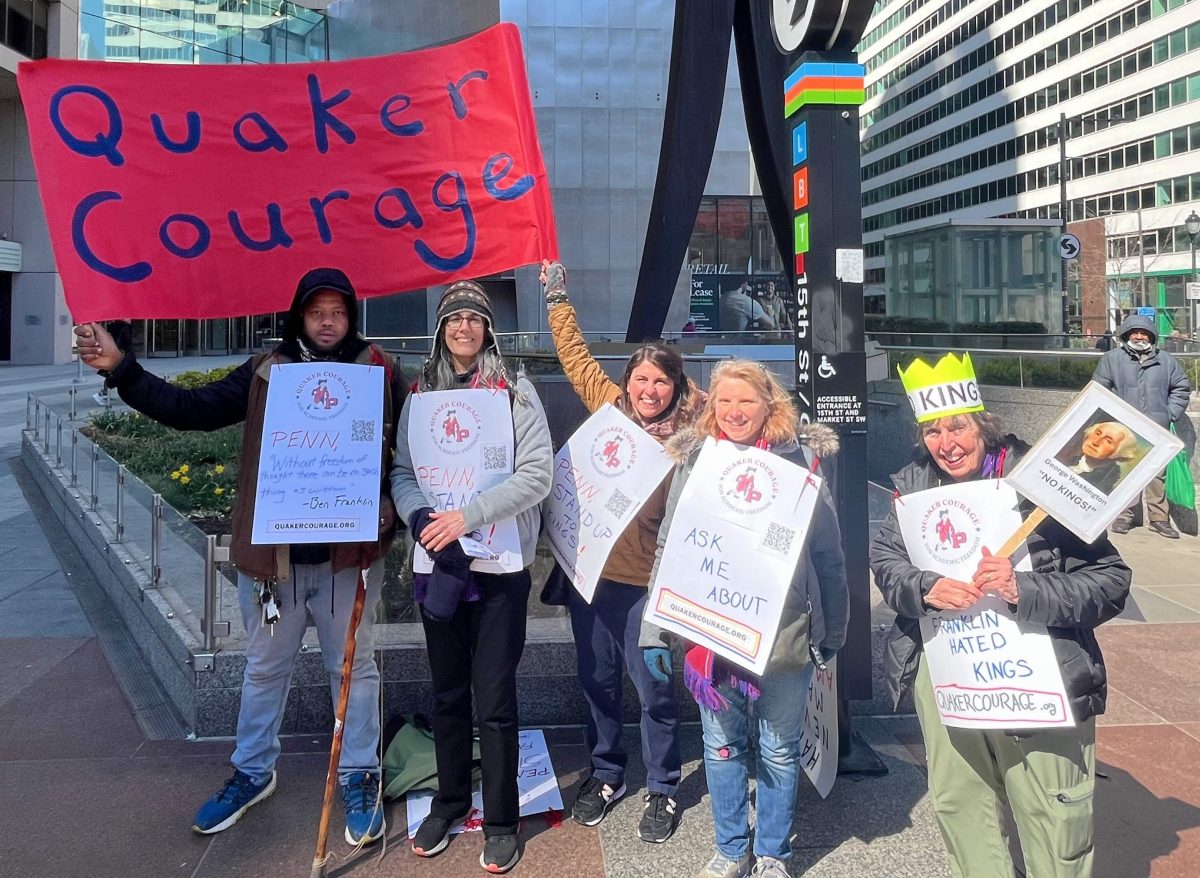
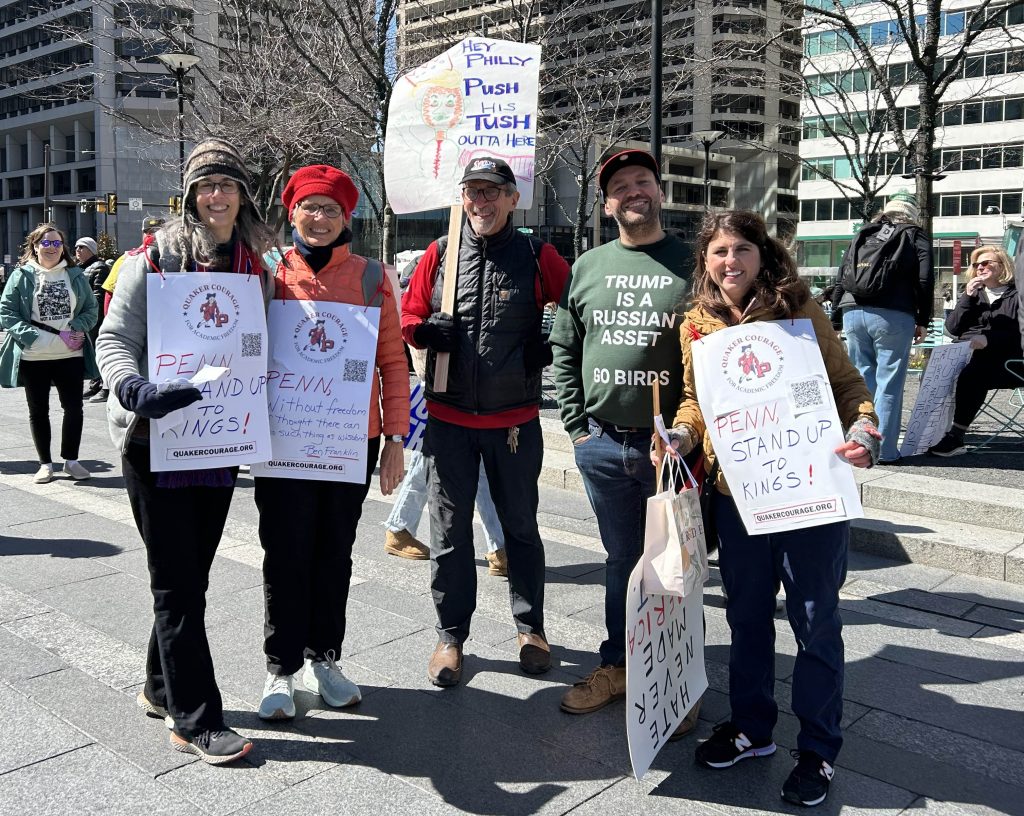
March 28, members and friends of Quaker Courage joined with about 40,000 other people to march from Philadelphia’s City Hall toward the Art Museum. Our group spread the word about Quaker Courage and our goal to help Penn stand up to the Trump administration.

During the March 28 event we wore fun signs with the Quaker Courage logo, a QR for the petition, our web site address, and a variety of messages including “What’s up, Penn?”, “Fascist fear academic Freedom”, and “‘Without freedom of thought there can be no wisdom.’ — Ben Franklin”

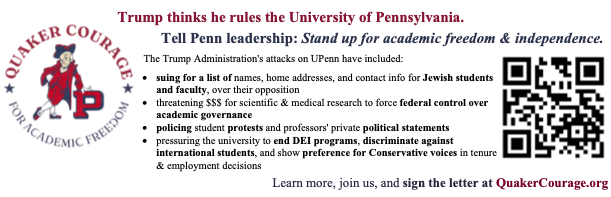
Together we handed out hundreds of flyers explaining the key issues we are watching and requesting signatures on our letter to Penn President J. Larry Jameson and the Board of Trustees.

Flyer handed out at No Kings 3 in Philadelphia

Within 24 hours of the No Kings 3 rally in Philadelphia, we added about 100 signatures to our letter.

Our next big event will be at Penn’s graduation and alumni weekend. Mark your calendars for May 15 – 18 and watch for more information.

Quaker Courage members at No Kings 3 in Philadelphia. March 28, 2026.

Federal Anti-DEI Edicts and Penn’s Responses

“The moment calls for courage”Chad Dion Lassiter, Executive Director, Pennsylvania Human Relations Commission and UPenn Social Work MSW graduate, quoted in the Philadelphia Inquirer, August 12, 2025

President Trump was inaugurated for the second time on January 20, 2025.

On January 21, 2025, the White House issued an executive order threatening the grant funding of higher education institutions that incorporate “diversity, equity, and inclusion” (DEI) programs.

By February 15, the Philadelphia Inquirer reported that Penn’s various schools had already started removing or rewording references to diversity, equity, and inclusion from their websites, at the direction of Penn’s highest-level administrators.

In contrast, Temple University and Drexel University indicated they would not make immediate changes to programming or language. (A quick glance at Temple’s website suggests the continued existence of programs declaring themselves as involving DEI. At Drexel, the description of an event held this month references Drexel’s “commitment to diversity, equity, inclusion, and belonging.”)

Then, in summer 2025, came Penn Carey Law School’s announcement that it would “pause” a full-tuition scholarship program named for Dr. Sadie T. M. Alexander, its first Black graduate. Furthermore, it would close its office of “equal opportunity and engagement” – formerly the office of “equity and inclusion,” which had evidently become forbidden words — by the end of August.

After an outcry from many quarters — including Chad Lassiter of the Pennsylvania Human Relations Commission, the agency that enforces PA state laws prohibiting discrimination; Sadie Alexander’s daughter Rae Alexander-Minter; the Philadelphia NAACP; the Penn Carey Black Law Students Association; and the Penn chapter of the American Association of University Professors (AAUP) – Penn Carey Law announced a new, two-year post-graduate fellowship program to be named for Sadie Alexander.

Two Penn Carey Law graduates, J. Huntley Palmer and Patricia L. Petty, in an Inquirer op-ed, point out, “Funding a two-year postgraduate fellowship is not remotely comparable to full tuition scholarships for three years at Penn Law, a current approximate value of $240,000, for up to five incoming law students.” A postgraduate fellowship does nothing to lower the barrier to entry for Black students applying to and attending Penn Law. As reported in The Daily Pennsylvanian, the number of Black students who enrolled in the 2025-26 first-year class is 50 percent lower than in the previous class, and the lowest number since the American Bar Association began requiring the disclosure of such data in 2011.

The decision to create the fellowship suggests that advocacy has an impact, that University leaders are sensitive to community reaction, but the choice seems designed to appease critics while still undoing a valuable scholarship program that benefited our country by enabling talented students to enter the field of civil rights law.

Palmer and Petty also noted that Georgetown University Law Center responded very differently to DEI-related threats from the Trump administration. In February 2025, the Georgetown Law dean received a letter from interim U.S. Attorney for Washington D.C. Ed Martin saying that Georgetown Law graduates would no longer be considered for positions in the U.S. Attorney’s office unless the school ceased teaching or promoting DEI. The dean replied unequivocally, stating in his return letter that “the constitutional violation behind this threat is clear.” A search of Georgetown Law Center’s website reveals that the school continues to have an Office of Equity and Inclusion, and the Office’s web page invites donations to “Support Diversity, Equity, and Inclusion at Georgetown Law.”

The swiftness of Penn’s attempts to comply with Trump’s executive orders suggests that Penn’s AAUP chapter was not exaggerating when it called the University’s response “anticipatory obedience”. Lassiter of the Human Relations Commission – who earned his master’s in social work from Penn in 2001 – said that Penn needed to share its thinking behind the swift changes, and that complying with federal government orders or pressures is not an adequate explanation. (https://www.inquirer.com/education/penn-law-school-scholarship-equal-opportunity-criticism-20250812.html)

“The moment calls for courage,” Lassiter said.

We at Quaker Courage could not agree more. While we recognize the dilemma faced by academic leaders whose institutions’ research and programs – some of which benefit members of marginalized communities – could be slashed by threatened funding cuts, we’ve seen time and again that when institutions of any kind bend to autocratic lawlessness, they embolden more of the same. Law schools, of all institutions, must be willing to fight in court for our constitutional rights.