“The moment calls for courage” – Chad Dion Lassiter, Executive Director, Pennsylvania Human Relations Commission and UPenn Social Work MSW graduate, quoted in the Philadelphia Inquirer, August 12, 2025
President Trump was inaugurated for the second time on January 20, 2025.
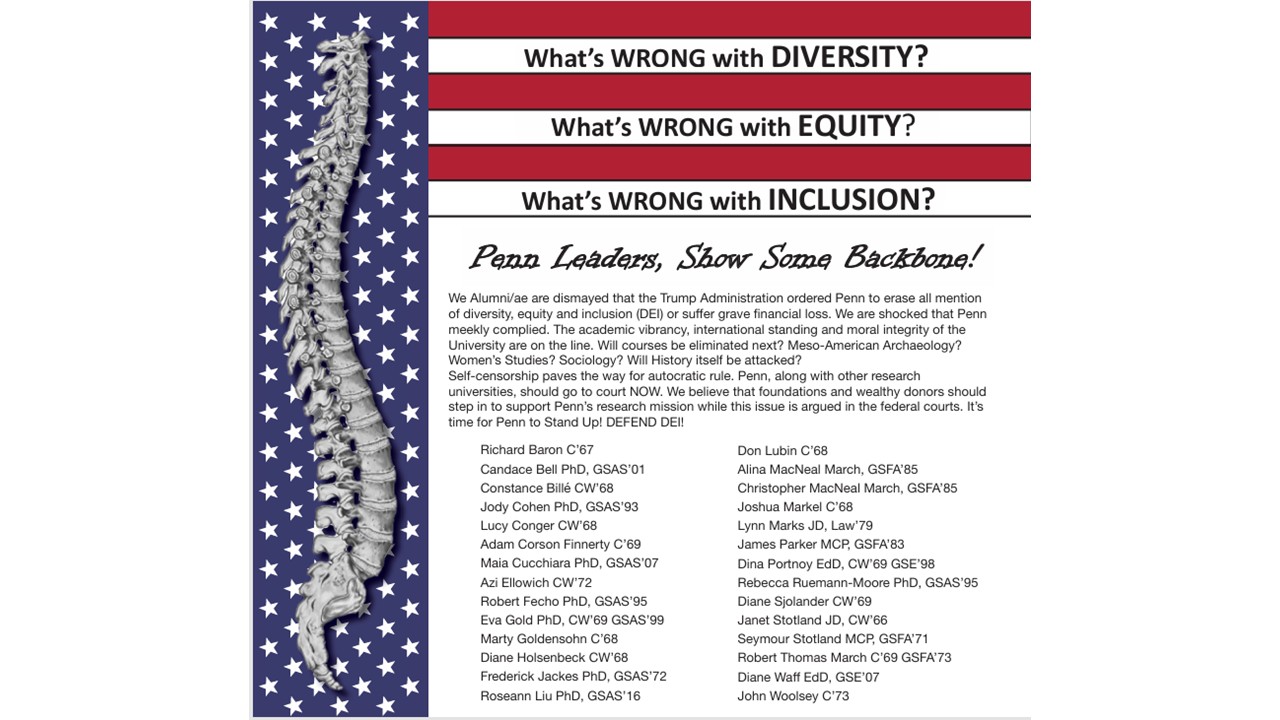
On January 21, 2025, the White House issued an executive order threatening the grant funding of higher education institutions that incorporate “diversity, equity, and inclusion” (DEI) programs.
By February 15, the Philadelphia Inquirer reported that Penn’s various schools had already started removing or rewording references to diversity, equity, and inclusion from their websites, at the direction of Penn’s highest-level administrators.
In contrast, Temple University and Drexel University indicated they would not make immediate changes to programming or language. (A quick glance at Temple’s website suggests the continued existence of programs declaring themselves as involving DEI. At Drexel, the description of an event held this month references Drexel’s “commitment to diversity, equity, inclusion, and belonging.”)
Then, in summer 2025, came Penn Carey Law School’s announcement that it would “pause” a full-tuition scholarship program named for Dr. Sadie T. M. Alexander, its first Black graduate. Furthermore, it would close its office of “equal opportunity and engagement” – formerly the office of “equity and inclusion,” which had evidently become forbidden words — by the end of August.
After an outcry from many quarters — including Chad Lassiter of the Pennsylvania Human Relations Commission, the agency that enforces PA state laws prohibiting discrimination; Sadie Alexander’s daughter Rae Alexander-Minter; the Philadelphia NAACP; the Penn Carey Black Law Students Association; and the Penn chapter of the American Association of University Professors (AAUP) – Penn Carey Law announced a new, two-year post-graduate fellowship program to be named for Sadie Alexander.
Two Penn Carey Law graduates, J. Huntley Palmer and Patricia L. Petty, in an Inquirer op-ed, point out, “Funding a two-year postgraduate fellowship is not remotely comparable to full tuition scholarships for three years at Penn Law, a current approximate value of $240,000, for up to five incoming law students.” A postgraduate fellowship does nothing to lower the barrier to entry for Black students applying to and attending Penn Law. As reported in The Daily Pennsylvanian, the number of Black students who enrolled in the 2025-26 first-year class is 50 percent lower than in the previous class, and the lowest number since the American Bar Association began requiring the disclosure of such data in 2011.
The decision to create the fellowship suggests that advocacy has an impact, that University leaders are sensitive to community reaction, but the choice seems designed to appease critics while still undoing a valuable scholarship program that benefited our country by enabling talented students to enter the field of civil rights law.
Palmer and Petty also noted that Georgetown University Law Center responded very differently to DEI-related threats from the Trump administration. In February 2025, the Georgetown Law dean received a letter from interim U.S. Attorney for Washington D.C. Ed Martin saying that Georgetown Law graduates would no longer be considered for positions in the U.S. Attorney’s office unless the school ceased teaching or promoting DEI. The dean replied unequivocally, stating in his return letter that “the constitutional violation behind this threat is clear.” A search of Georgetown Law Center’s website reveals that the school continues to have an Office of Equity and Inclusion, and the Office’s web page invites donations to “Support Diversity, Equity, and Inclusion at Georgetown Law.”
The swiftness of Penn’s attempts to comply with Trump’s executive orders suggests that Penn’s AAUP chapter was not exaggerating when it called the University’s response “anticipatory obedience”. Lassiter of the Human Relations Commission – who earned his master’s in social work from Penn in 2001 – said that Penn needed to share its thinking behind the swift changes, and that complying with federal government orders or pressures is not an adequate explanation. (https://www.inquirer.com/education/penn-law-school-scholarship-equal-opportunity-criticism-20250812.html)
“The moment calls for courage,” Lassiter said.
We at Quaker Courage could not agree more. While we recognize the dilemma faced by academic leaders whose institutions’ research and programs – some of which benefit members of marginalized communities – could be slashed by threatened funding cuts, we’ve seen time and again that when institutions of any kind bend to autocratic lawlessness, they embolden more of the same. Law schools, of all institutions, must be willing to fight in court for our constitutional rights.